Understand the importance of law firm efficiency

The Inconvenient Reality of Law Firm Security Challenges

Attorneys at small- to mid-sized law firms know there is usually more work than time in most days. That’s just how it is when you are staffed to provide legal services, but not necessarily marketing, office administration, accounting, or any of the other responsibilities that larger law firms can delegate to dedicated personnel. This is more than just an inconvenient fact of life. It’s a potentially fatal flaw, because administrative duties pull attorneys away from profitable work, thus dragging down a firm’s efficiency and putting its overall viability at risk.

“Efficiency” can be defined as the time it takes to complete a given task. In a law firm context, it pertains to the time and effort needed to carry a matter from intake to paid invoice. Obviously, the more efficient this process, the better a firm’s bottom line. And yet, an overwhelming majority of firms have ignored streamlining this area of their operations.

In a report from the Thomson Reuters Institute, 74% of the 400 law firm respondents said spending too much time on administrative tasks was at least a “moderate” challenge. That’s up 2% from the previous year. While it’s a small uptick, it shows that firms failed to make headway on this challenge. Not only that, it is becoming more of a problem.

That point is underscored by how law firms define “success.” 85% say it’s based on overall profits. By clogging a lawyer’s day with non-billable work, inefficiency corrodes profits and dilutes the most important measure of success for many firms.

If any further proof is needed, consider these 3 areas where a lack of efficiency creates serious structural problems:

How Can Your Law Firm Benefit From Managed IT Services?

Client dissatisfaction: In the era of on-demand entertainment and restaurant-to-door delivery service, is it any wonder clients want results immediately? That may not be possible, of course, but it’s still true that a lawyer who is not able to operate efficiently cannot attend to client matters quickly. The less time a lawyer has to spend on non-client work, the more quickly any given billable task can be handled.

Lower-quality work product: Quality legal work demands focus, and that’s hard to do when you’re dealing with issues other than practicing law. Attorneys who focus primarily on their clients’ matters produce a much higher-quality finished product that leads to happier, more loyal customers.

Attorney burnoutBurnout is a tremendous issue for the legal profession. For lawyers at small- to mid-sized firms, a major cause is trying to do everything alone. When “everything” includes too much non-billable work, lawyers become exhausted performing tasks that don’t bring in any money. That is inefficiency at its worst.

In the end, no attorney needs another thing on his or her plate. Efficiency is worthy of special consideration, however. Because, in its absence, the prospect of ultimate failure increases.

10 out of the box questions to ask a law firm interviewer

Being assertive in an interview

Any candidate going for an interview has to have a level of preparedness in them to be successful. Being able to answer questions confidently and accurate is the secret code to cracking any interview.

However, you can go one step better to catch your interviewer’s attention with the kind of questions you ask. If you’re being interviewed at a law firm, here are 10 out-of-the-box questions that you can ask your interviewer.

What stands out for you in my CV to make you believe that I can handle this role?

This question is one that allows you to get insight from your interviewer. If you’re doing well enough and they’re considering you, you’ll know from the response, and the same thing applies if you aren’t doing well enough. If it’s the latter, you might get some ideas on making your resume better from their response.

What qualities do I need to be successful at this job?

This question passes an air of confidence and optimism around you like you know you already have the job and are looking to do well. This is impressive for any interviewer, and you’re sure going to learn a thing or two about the necessary qualities you need.


What’s your most exciting work experience since you’ve been at the firm?

This is a personal question to the interviewer, and if they’re going to answer it, they’ll have to be personal in their answer. What this does is to make you both familiar and create an atmosphere of friendliness between you both. This is good to ease tension (if you’re tense) and make you more relaxed.

Who would I work closely with if I’m in this position?

This question allows you to know more about the role you’re interviewing for at the firm. You also get to learn about people you’ll be working with and their respective roles. What’s more? It creates anticipation between interviewer and interviewee and shows you’re eager to work at the firm.

If I’m to work with you in this role, how would you utilise my skill set?

This is an ideal question for when you’ll be working closely with your interviewer at the firm (if you’re employed). It turns the table against them. Now you’re interviewing them because you believe in your skill set and what you’re bringing to the firm. Trust me; they wouldn’t want to lose you.

What’s the outlook for this firm in the next five years?

As a professional, your personal growth is essential, and the firm you work at can either hinder you or help you grow. So, it’s smart of you to ask about how the firm is evolving. If the firm isn’t growing, you’ll likely not grow too.

Why did you decide to work for this firm?

Ideally, this is a question that they should ask you or might have asked you. Here you are turning the table against them. Their response to this question will give you an idea of what the firm is like and its evolution in recent years.

What’s the biggest challenge the firm is currently facing?

Every company faces one form of the problem or the other at different times of their existence. So, the firm interviewing you may have challenges they’re yet to resolve. Some of these challenges might stem from the industry’s evolution, technology changes, the need for new strategies, etc. You have to know your new employers’ significant concerns, so you know what you’re coming into. You’ll discover challenging areas for the firm by asking this question and how your skill set can be an effective solution for them.

What’s the biggest opportunity that the firm has currently?

There are specific questions that you have to ask during the interview process for the sake of your personal and professional growth. This is another one of those questions. If the company has a good record of finding and exploring new business opportunities, that’s a positive sign. It means that they have something to offer you. This could mean that you have a workplace with a stable environment where you’ll have the opportunity to move your career forward.
When you ask a question like this, it gives the interviewer an idea that you want the firm to succeed and care for its growth.


Are there any concerns that might disqualify me from this job?

Most of the time, companies require a particular skill set from their prospects and have to satisfy this before you’re considered for the job. You’re being interviewed because you meet some qualifications, but there are other candidates, and they may have more of the skill set that the company needs.
When you ask a question like this, you can get an idea of whether or not you’ll be getting the job. If not, you’ll know those things you need to improve on and the skill sets you have to hone.

Conclusion

While you have the opportunity to ask questions during the interview process, that’s primarily not your role, and the interviewer isn’t obliged to answer all your questions. However, you can make an impression with some of these questions. Contact us for more information.

7 skills for a successful law career

Commercial awareness

What Is Commercial Awareness And Why Is It Important?

One of the most important skills lawyers need, it basically means possessing knowledge of current developments in local, national and world business, particularly any issues that impact a law firm and its clients.

Firms expect employees to market their services to prospective clients, as well as develop trusting relationships with existing ones. Ultimately, law firms are businesses, so lawyers must appreciate the commercial importance of meeting deadlines, keeping costs low and handling information confidentially.

A client, meanwhile, expects their lawyer to fully understand how their business is run, and which wider social, political and economic issues may affect them. If applicable, lawyers must also appreciate the short, medium and long-term implications of their client’s business proposal, and think strategically about the organisation’s strengths, weaknesses, opportunities and threats. This enables the lawyer to provide pragmatic, business-minded legal advice to the best of their ability.

Improve your commercial awareness by:

  • becoming a committee member of a university club or society
  • browsing specialist websites such as RollOnFriday, LawCareers.Net, The Lawyer, Legal Cheek and Legal Futures
  • gaining work experience at a commercial organisation such as a bar, call centre, department store or, if possible, a law firm
  • going on a gap year, as this will develop your budgeting, scheduling and cost-cutting skills, and give you an international perspective on business issues
  • joining industry-specific forums that allow you to attend seminars and network with business professionals
  • listening to business-related podcasts or radio shows, such as BBC Radio 4’s Today programme
  • reading business publications such as the Financial Times and The Economist, and the business pages of a daily newspaper such as The Times
  • watching business-related television programmes such as Newsnight and Panorama.

You’ll be expected to show commercial awareness during the application process by demonstrating a thorough knowledge of the firm you’re applying to. It’s also likely that you’ll be tested during an assessment day. You may be asked questions such as:

  • What business deal or story has most interested you recently?
  • In x business deal what role did the firm play?
  • How could the firm prepare for an economic downturn?

Attention to detail

Attention To Detail - STUMINGAMES

Accuracy is pivotal to the success of your legal career. A single word out of place can change the meaning of a clause or contract, while misspelt or ungrammatical emails, letters or documents give clients a bad impression, costing your firm their business.

When applying for jobs or training contracts remember that employers look for spelling, punctuation and grammatical errors. If your cover letter is vague, too long or littered with spelling mistakes, a recruiter may question what a potential client would make of your letter of advice. To improve attention to detail, volunteer your proofing services to student publications and get used to going through your own work with a fine-tooth comb.

Communication

How to Use Technology to Streamline Communication in the Office –  Technology Signals

Strong oral and written communication skills are crucial and without them you’ll struggle to carry out the duties of a solicitor effectively. Excellent listening ability is also important when working with clients, as you need to be able to build relationships and engender confidence.

You need to be a confident speaker when arguing a case in court, negotiating settlements and explaining complex information to clients. You’ll have to use persuasive, clear and succinct language. Public speaking is also required in the role of a barrister. To hone this skill while at university, volunteer as the spokesperson in group activities or get involved in debate teams.

Written ability is equally important when drafting letters and legal documents. You’ll need to know technical and legal language and be able to convey it clearly and concisely. To improve your written communication skills, get involved with your university’s law society. You could take meeting minutes, draft emails, write newsletters or manage social media accounts.

Teamwork

You’ll work alongside a variety of people and winning cases will be a team effort. Solicitors need to collaborate with colleagues and partners in their firm, as well as liaise with clients. Barristers need to foster a close working relationship with their clerks and will often work high-profile cases alongside other barristers. The ability to work as part of a team is essential and you’ll need to be able to deal with people from all levels of the legal hierarchy, from trainees and pupils, to members of the judiciary.

It’s also vital that clients trust their legal representatives, so you’ll need to be personable, persuasive and polite.

The easiest way to hone your people skills is to join a team. This could be a sports team, drama club or choir – anything that enables you to work with others. Alternatively, get involved with editing the student newspaper or join a debating society. Part-time work in a customer service role is another way to improve this skill. Discover how to balance work and study.

Information analysis and research

Reading large amounts of information, absorbing facts and figures, analysing material and distilling it into something manageable is a feature of any law career.

Being able to identify what is relevant out of a mass of information and explain it clearly and concisely to your client is key. Hone this skill by taking large documents or long news articles and making five-point bulleted lists of the most important themes.

Research also plays a huge role in a lawyer’s day-to-day job. You’ll need research skills when doing the background work on a case, drafting legal documents and advising clients on complicated issues. Use your time at university to familiarise yourself with internet and library resources and build up a network of contacts. As a newly qualified solicitor or barrister industry connections can prove to be a useful source of advice.

Organisation

Researching points of law, drafting legal documents and contracts, managing case files, meeting clients, attending court and networking with legal professionals – it’s fair to say that the life of a solicitor or barrister is one big juggling act. The ability to prioritise and remain focused among competing priorities is essential and that’s why organisational skills are so important.

You’ll have plenty of opportunity to hone this skill throughout your training and work experience. To demonstrate it to employers you could mention how you held down a part-time job or the membership of a society while studying. Or perhaps you organised an event.

Creative problem solving

Some may think that the legal profession provides little outlet for an individual’s creative talent but this simply isn’t the case. No matter which legal career you choose you’ll frequently have to think outside the box to get the job done.

As all experienced solicitors and barristers know, the best course of action isn’t always the easiest or the most obvious. To outmanoeuvre opposing parties and secure a positive result for your client you’ll need to employ your creative thinking and problem-solving skills on an almost daily basis.

A good way to develop these abilities is to take part in student competitions, such as mooting, become a student representative or gain a position on your students’ union.

Other useful skills

  • Resilience and self-confidence – when it comes to standing out from the crowd, determination and enthusiasm go a long way – as does resilience and confidence in your own abilities. Don’t be overwhelmed by difficulties in securing a training contract or pupillage. Have the confidence to apply (and re-apply if necessary), seeking and acting upon feedback. Do you need to develop your skills further or gain a better understanding of the profession? Do you know how to sell your experience against the skills required?
  • Initiative – while being able to work successfully as part of a team is essential, there’ll be instances where you have to show initiative and independence. You’ll sometimes have to make quick decisions, without conferring with colleagues.
  • The ability to work under pressure – solicitors and barristers manage heavy workloads to tight deadlines and the outcome of this work has the potential to have a lasting impact on the lives of their clients.

Thanks to law courses and legal work experience many students and graduates already have these skills and the potential to succeed, but they just don’t know how to use relevant examples to illustrate these abilities. It takes practice to get it right. If you are interested just contact us for more information.

What Does A Personal Injury Lawyer Do?

Personal injury lawyers appear to be everywhere these days: TV, radio, billboards, movie theaters, YouTube, newspapers, magazines, and social media. But what do they do?

In simple terms, personal injury lawyers are lawyers that help people who have been physically or psychologically injured as the result of the negligence or intentional act of another party.

Personal injury lawyers are civil lawyers. They primarily handle negligence and intentional tort cases. Civil lawyers are typically retained to recover money from one person on behalf of another. When a person brings a civil action against another, a civil lawyer is usually retained to bring the lawsuit. The injured party will hire a personal injury lawyer when a dispute involves reimbursement or payment of medical expenses from an injury. Once retained, a personal injury lawyer will attempt to negotiate a settlement of the case. The personal injury lawyer will subsequently file a lawsuit if negotiation fails. A lawsuit is a civil legal action where one party sues another for money or property. The person suing is typically called the plaintiff. The defendant is the person sued.https://www.youtube.com/embed/CPEmlUKC5rU

What Types of Cases Do Personal Injury Lawyers Handle?

Personal injury lawyers handle several types of negligence cases that involve car accidents, truck accidents, aviation accidents, medical malpractice, legal malpractice, child daycare negligence, wrongful death cases, and other types of negligence cases. Negligence occurs when someone fails to use reasonable care to avoid causing injury or loss to another person. In other words, negligence occurs when one person carelessly injures another person.

For example, in a Florida motor vehicle accident or trucking accident, negligence occurs when one person carelessly operates a motor vehicle and causes damage or injury to another. In a Florida premises liability case, negligence occurs when a premises owner carelessly maintains his or her premises, such that the premises cause injury to another (i.e., a slip and fall or trip and fall case). In medical malpractice or medical negligence cases, negligence occurs when a medical professional fails to provide the standard of medical care that a reasonably prudent medical professional would have provided under similar circumstances. Finally, a products liability case arises when a manufacturer places a defective product into the stream of commerce that causes harm to consumers. In these situations, a personal injury lawyer is retained to negotiate the potential case and file a lawsuit against the defendant.

Alternatively, an intentional tort occurs where a person intentionally causes injury to another. For example, a car accident is simply that — an accident. In a car accident case, there is no intent to harm you, only negligence on the part of the negligent driver. However, an intentional tort occurs when a person intentionally rams another vehicle, or assaults or batters another person. In some cases, businesses are liable where an employee intentionally touches, strikes, or batters a customer.

If you believe that you have been a victim of negligence or an intentional tort, call us.

Latham & Watkins LLP

About Latham & Watkins LLP

Latham is one of the world’s largest law firms, a bona fide member of the clique that includes the Magic Circle and the elite U.S. heritage firms. With more than 2,800 attorneys in 29 offices around the world, Latham practices in all the major jurisdictions in the U.S., Europe, the Middle East, and Asia and regularly represents companies doing business in Latin America and Africa. The firm is a global leader in corporate transactions, environmental law, finance matters, litigations and trials, and tax services.

Small Shop Gets Super Sized

Dana Latham—former commissioner of the IRS—and Paul Watkins founded the firm in 1934 to focus on tax and employment law. In the latter part of the 20th century, the firm began aggressively and steadily expanding around the globe. The firm’s largest office is its New York location—the firm is preparing to move into an iconic new space on Sixth Avenue. Despite its sprawling footprint, Latham has long disavowed the notions of headquarters and “satellite” offices, with the firm proudly touting its “one-firm” culture. Latham extends this cultural ideal in a truly unique way: by including an equal number of partners and associates on its Associates Committee, which plays a central role in the firm’s evaluation and promotion process as well as in determining associate compensation and other policy issues.

Wide-Ranging Experiences

Junior associates at Latham are part of the firm’s “Unassigned Program” and can experience assignments across areas—which at Latham includes multiple top-ranked practices. In Vault’s recent practice area rankings, the firm placed in a whopping 25 areas. The firm’s recognized practices are wide-ranging and include everything from environmental law and project finance to health care and securities to intellectual property and white-collar defense—plus so much more.

But just because juniors are unassigned doesn’t mean they have no direction; the firm offers extensive training at all levels. First years are trained through the firm’s core curriculum, which focuses on practical lawyering skills like legal research, persuasive writing, contract drafting, practice management, document review, due diligence, and more. The firm also offers training academies that take place over several days and are based on specific skill levels from summer associates all the way through new partners.

Perks for Parents

In addition to the firm’s generous parental leave policies (we’re talking up to 26 weeks of paid leave for birth mothers, 22 weeks of paid leave for adoptive parents, and 14 weeks of paid leave for other parents), Latham also helps new parents transition into and out of parental leave through its PRO-RATA program, which is a “pace reduction” program that provides an automatic option to work at reduced hours for six months prior to and after returning from leave. Nursing mothers who travel for business can take advantage of breastmilk shipping, and this resource is also available to the spouses and domestic partners of Latham attorneys who don’t have access to a similar program through their employers. And benefit-wise, the firm offers both surrogacy reimbursement and financial assistance for adoptions and fertility treatments. No wonder the firm has been recognized as one of Working Mothers “Best Law Firms for Women” for more than 10 years.

COVID-19 Update

Latham held a substantive and rewarding summer associate program that took place virtually. We used advanced digital tools and technologies to ensure a successful program filled with meaningful substantive experiences and virtual exposure to the firm’s people, work, and culture. Summer program highlights include exclusive panels with speakers from Nasdaq and RBC Capital Markets, as well as workshops with world-renowned law professors on legal writing, negotiations, and authenticity in the workplace.

Latham is committed to hiring the best and brightest talent, and we continue to engage with recruits remotely.

News & Awards

RECENT NEWS

May 2020

Latham has an extensive relationship advising Facebook on matters ranging from M&A to litigation. Recent work includes representing Facebook in the acquisition of Giphy, an online database and search engine that provides a library of animated GIFs and stickers. Latham is also defending Facebook against a consolidated consumer class action regarding a criminal attack on Facebook’s web platform affecting approximately 29 million users globally. Through successful dispositive motions, the firm narrowed the case to a single named plaintiff pursuing a single cause of action and defeated class certification on a $6 billion damages claim for alleged identity theft.

April 2020

Latham was hired by the U.S. Soccer Federation (USSF) to replace its former counsel in a high-profile dispute with the U.S. Women’s National Soccer Team (WNT) regarding equal pay. Latham filed its first brief within a week of being hired, dropping prior counsel’s offensive arguments and reframing USSF’s legitimate defenses. The Court granted summary judgment for USSF on all of the WNT’s pay claims, acknowledging that USSF did right by the women players on everything it controls.

January 2020

Alongside the firm’s commercial work, Latham’s pro bono practice has developed into one of the world’s largest. In 2019, 98 percent of Latham’s U.S. lawyers participated; its lawyers around the globe opened nearly 900 matters and provided more than 224,000 hours of free legal services, valued at more than $172 million. Latham lawyers and staff pursue pro bono engagements in nearly every area of public interest law.

April 2019

Latham represented Daiichi Sankyo, a Japanese-based pharmaceutical company, in a groundbreaking $6.9 billion global agreement with AstraZeneca to co-develop and commercialize a clinical-stage novel antibody-drug product for cancer treatment, which was announced in April 2019. This has been a major development for the treatment of HER2 expressing diseases, including breast and gastric cancer. NOTABLE CASES

  • Latham advised Virgin Galactic on its merger with Social Capital Hedosophia, to create the world’s first publicly traded commercial human spaceflight company.
  • Latham represented Spotify in its groundbreaking direct listing in 2018, the largest innovation in becoming public since the Google Dutch auction model in 2004.
  • Latham obtained a company-saving result for Puma Biotechnology in the only private federal securities class action to reach a jury verdict in nearly 10 years.
  • The firm’s many appearances before the Supreme Court include the successful defense of the University of Texas’s use of race as a factor in admissions.

AWARDS & ACCOLADES

Why Work Here

Latham’s Summer Associates Program

4 local SEO hacks lawyers can use to rank #1 in Google My Business

Local SEO should be a focus for attorneys because most of the time people don’t look for legal services outside of their geographic location. Unfortunately, this often results in many firms fighting for visibility within a limited amount of online real estate.

You can be sure that your competition is constantly working to outrank you in search, so here are 4 essential tactics you can use to help increase your rankings.

1. Get a GMB (Google My Business profile)

Google dominates location-based search (mostly because they dominate search in general). If you haven’t claimed your GMB profile, which stands for Google My Business – also known as the local 3 pack – then you’re working at a major disadvantage. GMB profiles are some of the first organic listings people see when searching for law firms.

By default, many firms already have a GMB profile created by Google. Walk through the following process to claim it:

  1. Search for your firm in Google
  2. When you see the Knowledge Graph card for your firm, click on the ‘Are you the owner?’ link near the bottom.
  3. Start the process of verifying the firm’s ownership.

Note that Google will want you to verify ownership in one of two ways – either by phone or through regular mail. Typically, firms that have had a physical address for a long time and/or a more robust web presence will choose the phone option.

Once you’ve verified ownership, you can edit your GMB profile.

2. Add images to your GMB profile

Above all else, make sure your GMB profile is complete and contains accurate and consistent contact information. Beyond that, adding as many images as possible of your firm can help it rank far better in the local 3 pack.

In many cases, we’ve seen a correlation between higher rankings and having a significant number of photos in a GMB profile. By significant, we mean 20, 30, 40 photos or more. That may seem challenging for a law firm, but it’s okay to get creative.

Here are some image ideas to get you started:

  • show your offices (both inside and out)
  • show your team, partners, and yourself
  • describe the areas of law that you practice
  • show your logo
  • include tag lines, quotes, or other marketing messages

It doesn’t matter what the images are, as long as they are somewhat relevant to your firm or the areas of law you practice.

3. Onsite optimization: Adjusting website elements

Onsite SEO (the things done to your website structure to make it rank well) is one of the most meaningful tasks you can do to achieve good local rankings.

Start with a location-based page: Create a location-based page for the keyword phrases you want to rank for. An example could be ‘personal injury lawyer Philadelphia’ or ‘Detroit car accident attorney.’ Here are some tips:

  • Include the location in the copy of the page
  • Include the keyword phrase in the title, the headings, meta description and URL of the page
  • Include the keyword as an image file name of any images on the page
  • Include the keyword in any alt attributes of images on the page

Add NAP (name, address, phone number) to the header: Your firm’s name, address and phone number should be on the header of every page, but especially on location-based pages or pages that link to your GMB profile. This should also be the same information used in other listings around the web. Make sure it’s all consistent.

Improve page load time: If the page doesn’t load in less than a few seconds, improve the page speed. Leveraging technologies like AMP pages can significantly improve page-load time.

Substantial content: Include a lot of useful content on your pages. There’s no rule of thumb, but articles longer than 500 words is a good start. Do a search using the keyword phrase you want to rank for and look at what your competition is doing. See how much and what kind of content is on their pages and how it’s framed.

4. Citation signals: Mentions of your firm name across the internet

Along with the other tactics mentioned in this article, building citations is one of the most influential strategies for ranking well in local search. Citations are just mentions of your firm’s name on other websites such as directories, social media profiles, business listing websites, and data aggregators.

You can fill out profiles on your own or use a tool like Yext, which is a powerful citation-building tool. A subscription costs about $399 for a year; in return, Yext will disseminate your firm’s name, address, phone number and other information across hundreds of prominent websites.

Best of all, any changes you need to make can be done once, through one interface. The changes will be pushed to all the other sites online via Yext.

In addition to Yext, attorneys should seek out legal industry-specific directory listings. One of the most influential profiles to claim is your Avvo profile. These listings carry a lot of authority in search and often rank first for various practice area keyword phrases.
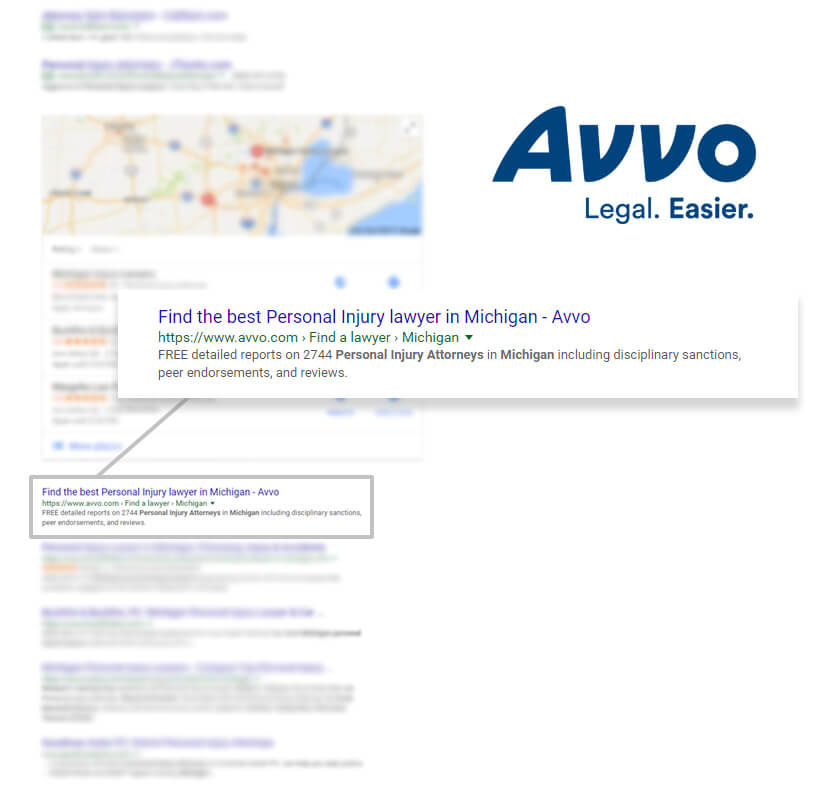
Building citations like this help create a consistent online presence for your firm. And according to Moz’s annual study of local search ranking factors, consistency is a huge ranking factor in local search.

Many attorneys serve local markets, so performing tasks like these on your web presence can help you rank on page one for relevant keyword phrases. The more you increase your visibility in local search, the more client leads you will obtain.

[Read More …]

Thank you for reading our blog here at Smith Kendall Law Firm

Local SEO should be a focus for attorneys because most of the time people don’t look for legal services outside of their geographic location. Unfortunately, this often results in many firms fighting for visibility within a limited amount of online real estate.

You can be sure that your competition is constantly working to outrank you in search, so here are 4 essential tactics you can use to help increase your rankings.

1. Get a GMB (Google My Business profile)

Google dominates location-based search (mostly because they dominate search in general). If you haven’t claimed your GMB profile, which stands for Google My Business – also known as the local 3 pack – then you’re working at a major disadvantage. GMB profiles are some of the first organic listings people see when searching for law firms.

By default, many firms already have a GMB profile created by Google. Walk through the following process to claim it:

  1. Search for your firm in Google
  2. When you see the Knowledge Graph card for your firm, click on the ‘Are you the owner?’ link near the bottom.
  3. Start the process of verifying the firm’s ownership.

Note that Google will want you to verify ownership in one of two ways – either by phone or through regular mail. Typically, firms that have had a physical address for a long time and/or a more robust web presence will choose the phone option.

Once you’ve verified ownership, you can edit your GMB profile.

2. Add images to your GMB profile

Above all else, make sure your GMB profile is complete and contains accurate and consistent contact information. Beyond that, adding as many images as possible of your firm can help it rank far better in the local 3 pack.

In many cases, we’ve seen a correlation between higher rankings and having a significant number of photos in a GMB profile. By significant, we mean 20, 30, 40 photos or more. That may seem challenging for a law firm, but it’s okay to get creative.

Here are some image ideas to get you started:

  • show your offices (both inside and out)
  • show your team, partners, and yourself
  • describe the areas of law that you practice
  • show your logo
  • include tag lines, quotes, or other marketing messages

It doesn’t matter what the images are, as long as they are somewhat relevant to your firm or the areas of law you practice.

3. Onsite optimization: Adjusting website elements

Onsite SEO (the things done to your website structure to make it rank well) is one of the most meaningful tasks you can do to achieve good local rankings.

Start with a location-based page: Create a location-based page for the keyword phrases you want to rank for. An example could be ‘personal injury lawyer Philadelphia’ or ‘Detroit car accident attorney.’ Here are some tips:

  • Include the location in the copy of the page
  • Include the keyword phrase in the title, the headings, meta description and URL of the page
  • Include the keyword as an image file name of any images on the page
  • Include the keyword in any alt attributes of images on the page

Add NAP (name, address, phone number) to the header: Your firm’s name, address and phone number should be on the header of every page, but especially on location-based pages or pages that link to your GMB profile. This should also be the same information used in other listings around the web. Make sure it’s all consistent.

Improve page load time: If the page doesn’t load in less than a few seconds, improve the page speed. Leveraging technologies like AMP pages can significantly improve page-load time.

Substantial content: Include a lot of useful content on your pages. There’s no rule of thumb, but articles longer than 500 words is a good start. Do a search using the keyword phrase you want to rank for and look at what your competition is doing. See how much and what kind of content is on their pages and how it’s framed.

4. Citation signals: Mentions of your firm name across the internet

Along with the other tactics mentioned in this article, building citations is one of the most influential strategies for ranking well in local search. Citations are just mentions of your firm’s name on other websites such as directories, social media profiles, business listing websites, and data aggregators.

You can fill out profiles on your own or use a tool like Yext, which is a powerful citation-building tool. A subscription costs about $399 for a year; in return, Yext will disseminate your firm’s name, address, phone number and other information across hundreds of prominent websites.

Best of all, any changes you need to make can be done once, through one interface. The changes will be pushed to all the other sites online via Yext.

In addition to Yext, attorneys should seek out legal industry-specific directory listings. One of the most influential profiles to claim is your Avvo profile. These listings carry a lot of authority in search and often rank first for various practice area keyword phrases.

Building citations like this help create a consistent online presence for your firm. And according to Moz’s annual study of local search ranking factors, consistency is a huge ranking factor in local search.

Many attorneys serve local markets, so performing tasks like these on your web presence can help you rank on page one for relevant keyword phrases. The more you increase your visibility in local search, the more client leads you will obtain.

[Read More …]

Thank you for reading our blog here at Smith Kendall Law Firm

Originally seen here

Lawyernomics 2017 Day 2 recap: How to be an entrepreneur, a lawyer, and a therapist for stressed out clients

In today’s online, demand-driven economy, understanding how to place the right bets on yourself and your practice is an important tool to have in your toolkit. The second day of Lawyernomics 2017 focused on what it means to be an entrepreneur in a changing industry, how to position your brand across platforms, and how to best support clients who are in a stressful legal situation.

Betting big in business

Las Vegas is about a lot of things, from hospitality, gambling, to entertainment, but at the heart of it, the city is really about people aspiring for a better tomorrow. And part of achieving that success, according to Tom Breitling, serial entrepreneur and author, is about taking risk and placing bets on yourself and your business. Here are a few ways you can leverage the Breitling mindset:

  1. Listen to customers. If you listen to your customers, they will give you the answers you need to build a successful business. Listen to what they want; don’t tell them what you think they need.
  2. Trust your partners – and your lawyers. Surround yourself with people you trust to help build your business. Without trust, success becomes much more challenging to achieve.
  3. Not every bet pays off, but don’t be afraid of failure. Losses can feel like a punch to the gut. But failure is a fact of life, and experience is what you get when you didn’t get what you wanted – and that experience is important.

The future of law in 30 minutes: three dynamic speakers share their vision for our profession in 6 minutes each

In six minutes and exactly 20 slides each, three speakers presented their argument for why what they contribute to the legal industry will help shape law in a positive way. Dan Lear, Director of Industry Relations at Avvo, encouraged attendees to take off their lawyer hats and listen to these visions of the future.

  1. Andrew Arruda on Artificial Intelligence. While many might think that AI is new, it’s actually been around for decades – and it’s not about robots. It’s software that is built to help human perform tasks more efficiently (in other words, your career is safe).
  2. Vanessa Vasquez de Lara on working to live, not living to work. You can design your firm to work for you if you are intentional about your life and work goals. If you’re failing to plan, you’re planning to fail. “My priorities are my family and vacations,” said Vanessa. “I take the time to plan and create the firm to allow me the time to do those things.” And make sure you hire the right people to help you – don’t spend your time on non-lawyer work.
  3. Nicole Abboud on how Millennials think. Growing you network online is a matter of deciding which neighborhoods you want to live in: Facebook, Twitter, and LinkedIn. Then, you can become a great neighbor by posting useful content to those who live next door.

In the hot seat: understanding how client stress can help grow your business

People with legal problems are stressed out. And stress makes people behave in ways they normally don’t, impairing their ability to think clearly. While this isn’t exactly new news for lawyers, the fact that you can help mitigate stress for your clients might be. Here are a few tips from Nika Kabiri, Director of Strategic Insights at Avvo:

  1. Communicate with your clients in a way that reduces stress. Provide them with clear information about what to expect from you and the legal process – and explain how you will help them resolve their legal issue.
  2. Understand that your clients may not remember things. Stress makes people forgetful. Repeat what you’ve told them both in-person, via email, and over the phone.
  3. Tell your clients what the final bill will be when possible. Seventy-seven percent of legal consumers worry about the price. Offering unbundled services or flat-rate billing can help alleviate this stress.

Reboot your law practice – you can learn to have a successful law practice

The legal industry is evolving and changing every day, making it challenging to be sure you’re staying in front of your target audience. Scott Limmer, lawyer and host of Reboot Your Law Practice podcast, explained how attorneys can stay relevant and thrive.

  1. Do a market evaluation. Understand how many potential clients there are versus how many lawyers are in your practice area and geography. This will help you pinpoint your market opportunity and business objectives.
  2. Learn how to be more efficient and productive. Evaluate your daily work and prioritize it by what tools you have available to do that work (do you have some down time in court and can write a quick blog post?), time available (is 30 minutes enough?), and energy reserves to complete the task. Check out The E-Myth Revisited: Why Most Small Business Don’t Work and What to Do About It and Traction: Get a Grip on Your Business for additional tips and tricks.
  3. Make sure you are acting as the CEO of your business. Create a business plan so that you have a clear vision of where you are going. Understand where you acquire your clients, where your time is being spent, and evaluate your income and expenses. You can and should hire help if you need it, just make sure you are in charge. It’s your business.

Betting on your brand

As a frequent legal commentator on local and national news stations including Fox News and CNN, and a regular contributor to Avvo’s Lawyernomics blog and industry publications, Jennifer Brandt, Co-Chair Family Law Department at Cozen O’Connor, has honed a successful brand as a thought leader and family law expert. She discussed the importance of building a brand as part of your overall marketing plan, and offered a few starting tips to help frame your personal and practice brand (s):

  1. Branding works best when we stay true to our authentic selves. Think about your best qualities and develop them. Understand the competition bud don’t feel compelled to copy. Clearly define your goals – where do you want to go?
  2. The relationships between brands and people needs to be made and remade. Reinforce what established the relationship in the first place, what attracted people to your brand, and make sure you stay true to that and your audience. You are often your business.
  3. Don’t let your bio get stale. Everything that you do, update your bio, your profile, your blog. Link your social profiles together when you have something to share – an event you’re attending, a speaking engagement, a new case – and give your clients and community a holistic view of what you offer at all times, from whatever platform they find you on.

Refine your LinkedIn message; communicate your personal and firm’s brand

As clients, lawyers, and other professionals all use LinkedIn to connect with other business-minded professionals, leveraging this social networking platform can have excellent benefits for your business growth. Marc W. Halpert, LinkedIn Trainer and Evangelist, shared tips for how to best optimize and manage their personal profile page whilst keeping branding and professional networking in mind:

  1. You are never a finished product. Always be evolving, learning, and innovating. There are always new ideas to adopt into your law practice, and you never know where these new things will take you.
  2. Know why you do what you do, and how your qualifications help your clients hire you. Your past determines your present, and your present determines your future. The skillset and value proposition you offer today will follow you into the future. You are in command of your future – it will offer you new opportunities when you tell why you and the skills and values you possess propel you.
  3. Be mindful of the words and headshot you use on your profile. Mix it up. Say what you need to say in your summaries on profiles, and make sure your photo communicates what you want your clients to think of you. Change up your language every once in a while. Share the why of what you do – convey your experience, passion, and what you’ll do for them.

Pro tip for LinkedIn – turn off your notification settings. You may not want all of your updates to be captured.

The report cards you never see

With an increasingly competitive market, it’s essential for lawyers to understand how their clients assess their performance so that they can maximize the generation of new business. Rob Thomas, VP Sales at Latitude Connect, walked us through actionable steps to ensure that you successfully serve and retain your clients:

  1. Adopt a satisfaction strategy. Send updates, minimize surprises. Provide status on a regular basis to reinforce value-adds. Discuss evaluation process. Understand rating system and ask for feedback.
  2. Keep correspondence simple for your clients. Be clear and concise in your communications with clients, whether it’s over email, on the phone, etc. Keep the contents down to tasks, meetings, decisions, and documents.
  3. Set realistic expectations. If you’re being judged on the criterion, make sure you’re a part of the process. Clarify value added. Explain challenges, quantify outcomes, share lessons learned.

Thank you for a fantastic Lawyernomics 2017! We enjoyed the past couple of days with all of the amazing attorney and sponsors who were able to make it to Las Vegas this year. Mark your calendars now for May 21 – 23, 2018, when Lawyernomics will take place at the Venetian Las Vegas.

[Read More …]

Thank you for reading our blog here at Smith Kendall Law Firm

In today’s online, demand-driven economy, understanding how to place the right bets on yourself and your practice is an important tool to have in your toolkit. The second day of Lawyernomics 2017 focused on what it means to be an entrepreneur in a changing industry, how to position your brand across platforms, and how to best support clients who are in a stressful legal situation.

Betting big in business

Las Vegas is about a lot of things, from hospitality, gambling, to entertainment, but at the heart of it, the city is really about people aspiring for a better tomorrow. And part of achieving that success, according to Tom Breitling, serial entrepreneur and author, is about taking risk and placing bets on yourself and your business. Here are a few ways you can leverage the Breitling mindset:

  1. Listen to customers. If you listen to your customers, they will give you the answers you need to build a successful business. Listen to what they want; don’t tell them what you think they need.
  2. Trust your partners – and your lawyers. Surround yourself with people you trust to help build your business. Without trust, success becomes much more challenging to achieve.
  3. Not every bet pays off, but don’t be afraid of failure. Losses can feel like a punch to the gut. But failure is a fact of life, and experience is what you get when you didn’t get what you wanted – and that experience is important.

The future of law in 30 minutes: three dynamic speakers share their vision for our profession in 6 minutes each

In six minutes and exactly 20 slides each, three speakers presented their argument for why what they contribute to the legal industry will help shape law in a positive way. Dan Lear, Director of Industry Relations at Avvo, encouraged attendees to take off their lawyer hats and listen to these visions of the future.

  1. Andrew Arruda on Artificial Intelligence. While many might think that AI is new, it’s actually been around for decades – and it’s not about robots. It’s software that is built to help human perform tasks more efficiently (in other words, your career is safe).
  2. Vanessa Vasquez de Lara on working to live, not living to work. You can design your firm to work for you if you are intentional about your life and work goals. If you’re failing to plan, you’re planning to fail. “My priorities are my family and vacations,” said Vanessa. “I take the time to plan and create the firm to allow me the time to do those things.” And make sure you hire the right people to help you – don’t spend your time on non-lawyer work.
  3. Nicole Abboud on how Millennials think. Growing you network online is a matter of deciding which neighborhoods you want to live in: Facebook, Twitter, and LinkedIn. Then, you can become a great neighbor by posting useful content to those who live next door.

In the hot seat: understanding how client stress can help grow your business

People with legal problems are stressed out. And stress makes people behave in ways they normally don’t, impairing their ability to think clearly. While this isn’t exactly new news for lawyers, the fact that you can help mitigate stress for your clients might be. Here are a few tips from Nika Kabiri, Director of Strategic Insights at Avvo:

  1. Communicate with your clients in a way that reduces stress. Provide them with clear information about what to expect from you and the legal process – and explain how you will help them resolve their legal issue.
  2. Understand that your clients may not remember things. Stress makes people forgetful. Repeat what you’ve told them both in-person, via email, and over the phone.
  3. Tell your clients what the final bill will be when possible. Seventy-seven percent of legal consumers worry about the price. Offering unbundled services or flat-rate billing can help alleviate this stress.

Reboot your law practice – you can learn to have a successful law practice

The legal industry is evolving and changing every day, making it challenging to be sure you’re staying in front of your target audience. Scott Limmer, lawyer and host of Reboot Your Law Practice podcast, explained how attorneys can stay relevant and thrive.

  1. Do a market evaluation. Understand how many potential clients there are versus how many lawyers are in your practice area and geography. This will help you pinpoint your market opportunity and business objectives.
  2. Learn how to be more efficient and productive. Evaluate your daily work and prioritize it by what tools you have available to do that work (do you have some down time in court and can write a quick blog post?), time available (is 30 minutes enough?), and energy reserves to complete the task. Check out The E-Myth Revisited: Why Most Small Business Don’t Work and What to Do About It and Traction: Get a Grip on Your Business for additional tips and tricks.
  3. Make sure you are acting as the CEO of your business. Create a business plan so that you have a clear vision of where you are going. Understand where you acquire your clients, where your time is being spent, and evaluate your income and expenses. You can and should hire help if you need it, just make sure you are in charge. It’s your business.

Betting on your brand

As a frequent legal commentator on local and national news stations including Fox News and CNN, and a regular contributor to Avvo’s Lawyernomics blog and industry publications, Jennifer Brandt, Co-Chair Family Law Department at Cozen O’Connor, has honed a successful brand as a thought leader and family law expert. She discussed the importance of building a brand as part of your overall marketing plan, and offered a few starting tips to help frame your personal and practice brand (s):

  1. Branding works best when we stay true to our authentic selves. Think about your best qualities and develop them. Understand the competition bud don’t feel compelled to copy. Clearly define your goals – where do you want to go?
  2. The relationships between brands and people needs to be made and remade. Reinforce what established the relationship in the first place, what attracted people to your brand, and make sure you stay true to that and your audience. You are often your business.
  3. Don’t let your bio get stale. Everything that you do, update your bio, your profile, your blog. Link your social profiles together when you have something to share – an event you’re attending, a speaking engagement, a new case – and give your clients and community a holistic view of what you offer at all times, from whatever platform they find you on.

Refine your LinkedIn message; communicate your personal and firm’s brand

As clients, lawyers, and other professionals all use LinkedIn to connect with other business-minded professionals, leveraging this social networking platform can have excellent benefits for your business growth. Marc W. Halpert, LinkedIn Trainer and Evangelist, shared tips for how to best optimize and manage their personal profile page whilst keeping branding and professional networking in mind:

  1. You are never a finished product. Always be evolving, learning, and innovating. There are always new ideas to adopt into your law practice, and you never know where these new things will take you.
  2. Know why you do what you do, and how your qualifications help your clients hire you. Your past determines your present, and your present determines your future. The skillset and value proposition you offer today will follow you into the future. You are in command of your future – it will offer you new opportunities when you tell why you and the skills and values you possess propel you.
  3. Be mindful of the words and headshot you use on your profile. Mix it up. Say what you need to say in your summaries on profiles, and make sure your photo communicates what you want your clients to think of you. Change up your language every once in a while. Share the why of what you do – convey your experience, passion, and what you’ll do for them.

Pro tip for LinkedIn – turn off your notification settings. You may not want all of your updates to be captured.

The report cards you never see

With an increasingly competitive market, it’s essential for lawyers to understand how their clients assess their performance so that they can maximize the generation of new business. Rob Thomas, VP Sales at Latitude Connect, walked us through actionable steps to ensure that you successfully serve and retain your clients:

  1. Adopt a satisfaction strategy. Send updates, minimize surprises. Provide status on a regular basis to reinforce value-adds. Discuss evaluation process. Understand rating system and ask for feedback.
  2. Keep correspondence simple for your clients. Be clear and concise in your communications with clients, whether it’s over email, on the phone, etc. Keep the contents down to tasks, meetings, decisions, and documents.
  3. Set realistic expectations. If you’re being judged on the criterion, make sure you’re a part of the process. Clarify value added. Explain challenges, quantify outcomes, share lessons learned.

Thank you for a fantastic Lawyernomics 2017! We enjoyed the past couple of days with all of the amazing attorney and sponsors who were able to make it to Las Vegas this year. Mark your calendars now for May 21 – 23, 2018, when Lawyernomics will take place at the Venetian Las Vegas.

[Read More …]

Thank you for reading our blog here at Smith Kendall Law Firm

Originally seen here

Shannon McNulty – Clifford Law Offices

Shannon McNulty - Clifford Law Offices
Shannon McNulty is a Partner at Clifford Law Offices in Chicago, Illinois. She handles many complex litigation cases, in particular, class action lawsuits.

Learn more about Clifford Law Offices at http://www.cliffordlaw.com

Thank you for reading our blog here at Smith Kendall Law Firm

Shannon McNulty - Clifford Law Offices
Shannon McNulty is a Partner at Clifford Law Offices in Chicago, Illinois. She handles many complex litigation cases, in particular, class action lawsuits.

Learn more about Clifford Law Offices at http://www.cliffordlaw.com

Thank you for reading our blog here at Smith Kendall Law Firm

Originally seen here

Susan Capra – Medical Malpractice Lawyer and Partner at Clifford Law Offices

Susan Capra - Medical Malpractice Lawyer and Partner at Clifford Law Offices
Susan Capra is a Partner at Clifford Law Offices on the Medical Malpractice Legal Team at Clifford Law Offices. She is also a registered nurse. She has been a medical malpractice lawyer for 25 years, working with Bob Clifford.

Get the answers and justice you deserve. Contact Clifford Law Offices at http://www.cliffordlawoffices.com

Thank you for reading our blog here at Smith Kendall Law Firm

Susan Capra - Medical Malpractice Lawyer and Partner at Clifford Law Offices
Susan Capra is a Partner at Clifford Law Offices on the Medical Malpractice Legal Team at Clifford Law Offices. She is also a registered nurse. She has been a medical malpractice lawyer for 25 years, working with Bob Clifford.

Get the answers and justice you deserve. Contact Clifford Law Offices at http://www.cliffordlawoffices.com

Thank you for reading our blog here at Smith Kendall Law Firm

Originally seen here

Robert Clifford – Founder and Senior Partner at Clifford Law Offices

Robert Clifford - Founder and Senior Partner at Clifford Law Offices
Bob Clifford is the Founder and Senior Partner at Clifford Law Offices in Chicago, Illinois. http://www.cliffordlawoffices.com. He marked his 40th year as a personal injury attorney. He talks about the care, dedication, and expertise his firm brings to all cases to support the families and individuals they serve.

Contact Clifford Law Offices for representation on complex cases including aviation, medical malpractice and product liability.

Thank you for reading our blog here at Smith Kendall Law Firm

Robert Clifford - Founder and Senior Partner at Clifford Law Offices
Bob Clifford is the Founder and Senior Partner at Clifford Law Offices in Chicago, Illinois. http://www.cliffordlawoffices.com. He marked his 40th year as a personal injury attorney. He talks about the care, dedication, and expertise his firm brings to all cases to support the families and individuals they serve.

Contact Clifford Law Offices for representation on complex cases including aviation, medical malpractice and product liability.

Thank you for reading our blog here at Smith Kendall Law Firm

Originally seen here